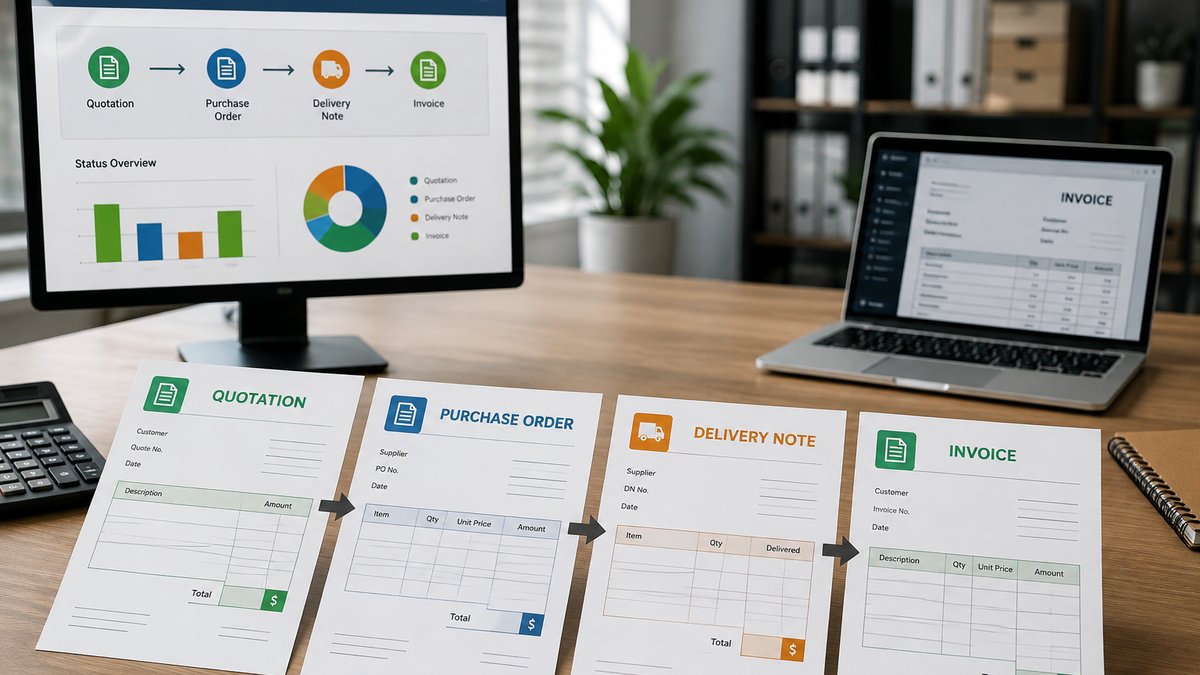
Many companies issue an invoice directly, without going through the intermediate steps. That works as long as everything goes well. The day a customer disputes a delivery or refuses to pay, the absence of a document chain is expensive.
The legal role of each document
The quotation
It is an offer. Until it is accepted it binds only you, and only within its validity period. Once signed by the customer, it becomes a contract.
Frequent mistake: leaving out the validity period. A quotation with no expiry can be held against you months later, when your costs have changed.
The purchase order
It records the customer’s agreement to the terms of the quotation. In business-to-business relationships it is often the customer who issues it with their own reference, which will have to appear on your invoice for payment to be processed.
The delivery note
This is the document proving the goods were handed over and accepted. Signed by the customer, it makes any later dispute about the contents of the delivery very difficult.
It is the most neglected document and the most useful one in a dispute. Without it, you have to prove delivery by other means, which is often impossible.
The invoice
This is the request for payment and the accounting document. It must carry the references of the preceding documents so that the chain can be reconstructed.
Why continuity matters
A continuous chain brings three concrete benefits. It removes re-keying, and with it errors of quantity and price. It lets you trace the origin of a discrepancy instantly. And it builds a solid file for debt recovery.
With the electronic invoicing reform, this discipline becomes even more decisive: an invoice rejected for inconsistency blocks the whole process. See our article on what the reform changes.
The mistakes that weaken recovery
- Invoicing without a signed delivery note, in trading activities
- Omitting the customer’s purchase order reference, which blocks payment in large organisations
- Modifying an accepted quotation without a written amendment
- Delivering partially without a partial delivery document
- Issuing a monthly consolidated invoice with no detail tied to the deliveries
What must appear on the invoice
Full identity of both parties, the company’s legal identifiers, continuous numbering with no gaps, date of issue, precise description of the goods or services, quantities and unit prices, VAT rate and amount, payment terms and due date, and the references of earlier documents.
Continuous numbering deserves particular attention: a break in the sequence is a signal examined during an inspection.
The case of down payments
A down payment calls for a down payment invoice, not a simple receipt. The final invoice must then explicitly deduct the amounts already invoiced. This is a classic source of double-counted VAT.
Frequently asked questions
Is a delivery note mandatory?
It is not systematically required, but its absence deprives you of proof of delivery. In trading activities it is indispensable in practice.
Can we invoice without a prior quotation?
Yes for routine services. But as soon as the amount is significant or the scope arguable, an accepted quotation protects both parties.
How do we correct an incorrect invoice?
With a credit note, never by modifying the issued invoice. With prior clearance, the original invoice is frozen in any case.
How SOLVIO handles this chain
Our ERP links each document to the previous one: the quotation becomes a purchase order, then a delivery note, then an invoice, with no re-keying and full traceability. See SOLVIO.