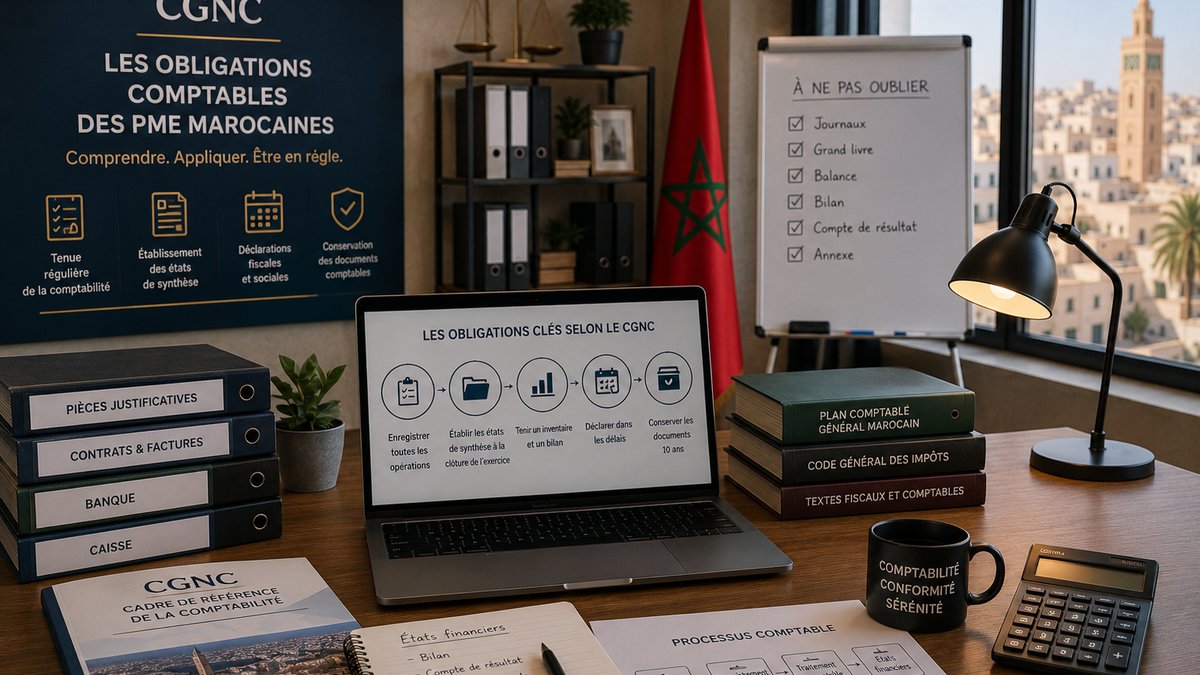
Many company directors discover the Code général de normalisation comptable at the moment of an inspection. That is late. This article summarises what the text requires, according to company size, and what departing from it costs.
A legal obligation, not good practice
The CGNC is made mandatory by law 9-88 on the accounting obligations of traders, promulgated by dahir of 25 December 1992. It is therefore not an optional framework but one whose observance can be required.
The code has two parts: the general accounting standard, which sets out the fundamental principles and valuation methods, and the Moroccan general chart of accounts, which fixes the nomenclature of accounts.
Standard model or simplified model
The determining threshold is annual turnover of ten million dirhams.
Below it, the business falls under the simplified model. Above it, it moves to the standard model, more demanding in terms of financial statements and analytical detail.
This shift often catches fast-growing companies by surprise: you cross the threshold without paying attention, and the following financial year imposes a presentation nobody was prepared for. Watch that indicator the way you watch your cash position.
What complying with the CGNC means in practice
- An account nomenclature compliant with the national chart of accounts, not an in-house one
- Regular upkeep of the journal, the general ledger and the trial balance
- Financial statements drawn up under the model matching your size
- Retention of supporting documents
- Observance of the principles of going concern, consistency of methods and matching of accounting periods
Penalties
Failure to meet accounting obligations exposes you to tax fines, with amounts commonly reported between five thousand and fifty thousand dirhams. But the direct financial penalty is not the main risk.
The real danger is rejection of the accounts during an inspection. When the administration considers the accounts not to be probative, it can reconstruct turnover by its own methods. The resulting reassessment, surcharges included, goes well beyond the amount of the initial fine.
The link with electronic invoicing
The electronic invoicing reform mechanically reinforces the accounting requirement. Structured, cleared invoices feed a continuous audit trail: the administration gains a view of flows it did not have before. Approximate accounting becomes far more visible. See our article on what the reform changes.
Frequently asked questions
Does a very small business have to comply with the CGNC?
Yes, in its simplified version. Size reduces the formality, it does not remove the obligation.
My accountant handles it, am I covered?
Responsibility remains with the company director. The accountant works from the documents you provide: if the document flow upstream is deficient, the accounts will be too.
Can a spreadsheet be enough?
For a very small activity, possibly. But a spreadsheet guarantees neither the audit trail, nor the integrity of entries, nor consistency of the account nomenclature. Those are precisely the points an inspection examines.
How SOLVIO answers these requirements
Our ERP embeds the Moroccan chart of accounts, generates the journal, the trial balance and VAT statements, and links every entry to its supporting document. Let us discuss how your accounting is organised.