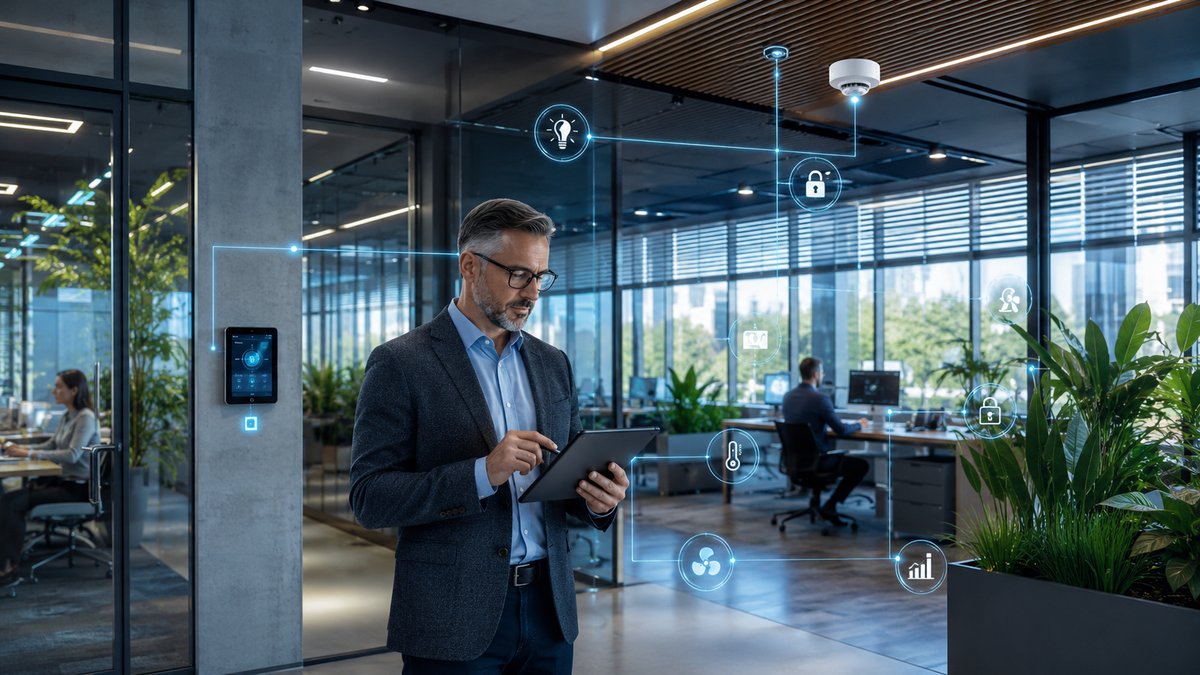
Building automation applied to business premises pursues a different goal from the home version: cutting measurable costs and securing access, not improving living comfort. That distinction changes what you install first.
Lighting: the fastest return
Presence detection in intermittently occupied areas — corridors, toilets, meeting rooms, storerooms — combined with dimming according to available daylight.
This is the use with the shortest payback, because the waste is massive and invisible: premises lit in the evening, at weekends, and empty rooms left on all day.
Controlled air conditioning
In the Moroccan climate, this is the largest consumption item in many premises. Control by zone and by time slot, interlocked with window openings, avoids two classic forms of waste: cooling unoccupied spaces and cooling with a window open.
A point often neglected: measurement. Without meters by zone, it is impossible to know where consumption goes or to prove the gain after the works.
Access control
Badges or codes replacing physical keys, with rights by zone and time slot, and a log of entries.
The decisive advantage is not security but administration: revoking a badge takes seconds, whereas changing a lock cylinder after a lost key requires a call-out and puts the access out of service.
Be aware: the entry log constitutes processing of personal data under law 09-08. See our article on data protection.
Technical monitoring
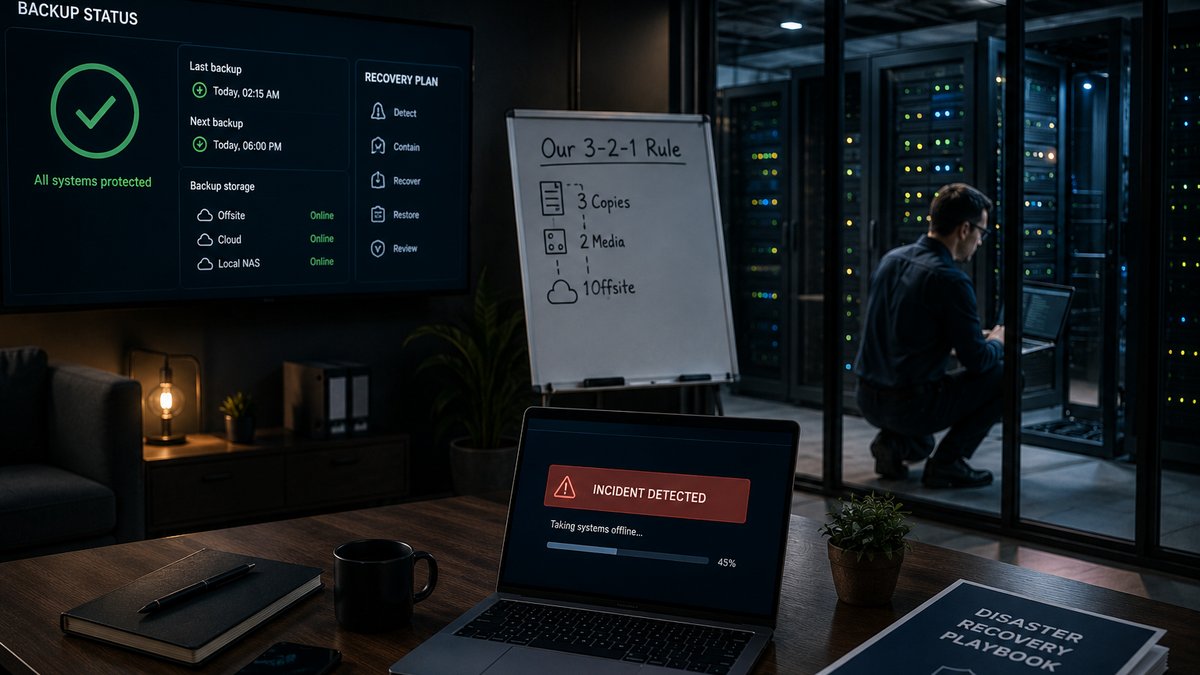
Alerts from critical equipment: server room temperature, tank level, UPS fault, power failure.
An alert received in time avoids a costly incident. A plant room whose cooling fails on a Friday evening announces itself on Monday morning, with the consequences you can imagine.
Installation mistakes
- Piling up incompatible technologies, which makes the whole unmanageable
- Choosing equipment that depends on an online service: if the vendor shuts down, the installation becomes unusable
- Neglecting degraded mode: what happens if the controller fails? Lighting must remain switchable by hand
- Connecting the controllers to the same network as the workstations, without segmentation
That last point deserves attention: automation equipment is rarely updated and makes a prime target. It must be isolated. See our article on designing a business network.
Frequently asked questions
Do we have to rewire the building?
Not systematically. Wireless or powerline solutions make it possible to equip an existing building, with range and reliability constraints to assess.
How long before the investment pays back?
For lighting and air conditioning, the order of magnitude is years rather than months, and it depends heavily on tariffs and occupancy patterns. Measuring consumption beforehand allows a serious estimate.
Can we equip the building progressively?
Yes, provided you choose a common technical base from the start, otherwise you end up with systems that do not talk to each other.
How we work
Systomap designs and deploys professional building automation: lighting, air conditioning, access control and monitoring. See our services.