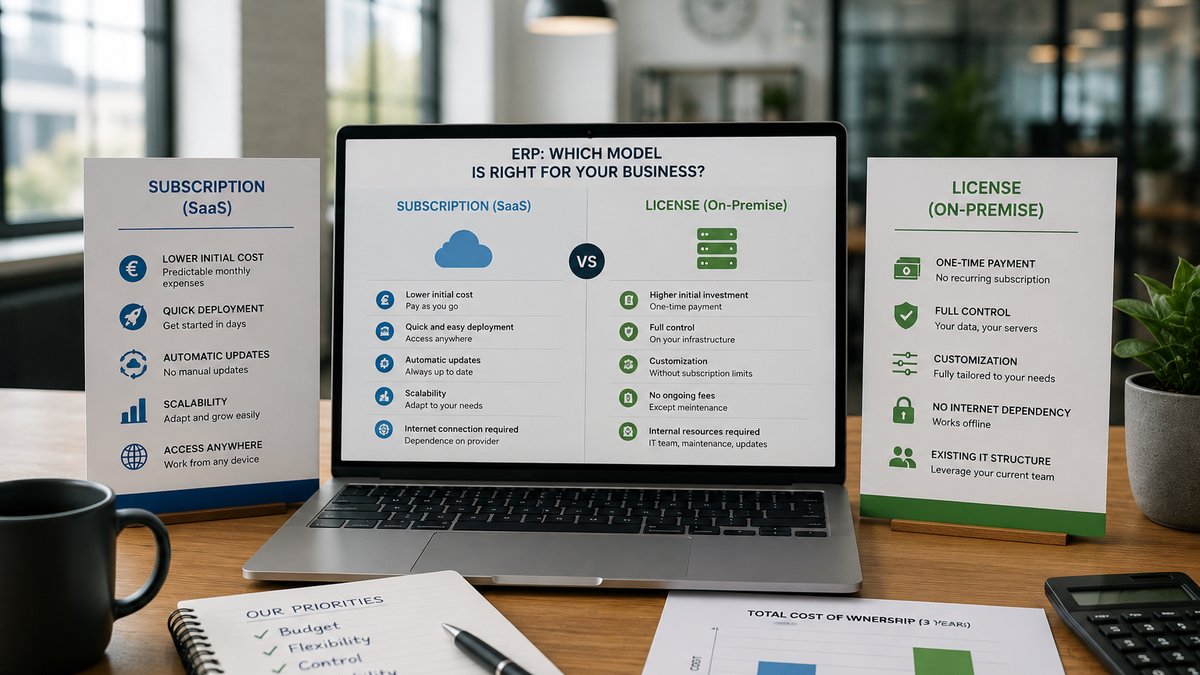
The question comes up in every ERP project, and it is almost always approached through price. That is the wrong angle: over five years the two models can come to the same figure. What separates them are the constraints they impose.
What each model involves
Subscription
The software is hosted by the vendor, you pay periodically, updates and backups are included. No upfront investment and no server to administer.
Installed licence
The software runs on your own infrastructure. You pay once, you control the hosting, you take on the maintenance.
The five criteria that actually decide
1. How sensitive your data is
Some activities require data to remain physically inside the company, by contractual constraint or at a client’s demand. If that is your case, the question is settled before it is even asked.
2. The quality of your connection
A subscription ERP assumes a stable internet connection. On a poorly served industrial site, an outage means invoicing and shipping stop. An installed licence keeps working over the local network.
3. Your in-house skills
A licence assumes someone able to administer a server, apply patches and watch over backups. Without that skill in-house or at a supplier, the apparent saving turns into a risk.
4. Your cash position
A subscription spreads the spend, a licence concentrates the investment at the start. For a growing company preserving its cash, the subscription holds up even if it costs more in the long run.
5. Reversibility
This is the most neglected criterion. What happens if you want to leave? On a subscription, check that you can export all your data in a usable format, and that you keep access to the history after termination. On a licence, make sure you have direct access to your database.
The honest cost calculation
Compare over five years, including on each side what people usually forget.
For the subscription: the price per user multiplied by expected headcount changes, modules charged extra, and the cost of specific development work.
For the licence: the server and its replacement, electricity and the UPS, the maintenance contract, off-site backup, and internal administration time, which is a real cost even if it appears on no invoice.
The hybrid model
Some solutions, including SOLVIO, offer both modes with the same software. The value is being able to change your mind: start on a subscription to move fast, then switch to a licence once the infrastructure and skills are in place. Or the other way round.
Frequently asked questions
Is a subscription less secure?
Not necessarily, often the opposite: a professional hosting provider applies measures an SME cannot afford to implement. The real issue is where the data sits and what the contract commits to.
Can you migrate from one model to the other?
With the same vendor and the same software, yes, without heavy data migration. Between two vendors, it is a full migration project.
What happens to data access if the vendor disappears?
With a licence, you keep the installed software and your database. With a subscription, that is the point to secure contractually, along with regular exports on your side.
Where we stand
SOLVIO is offered in both modes, with the same features. See our guide to choosing compliant software or get in touch.