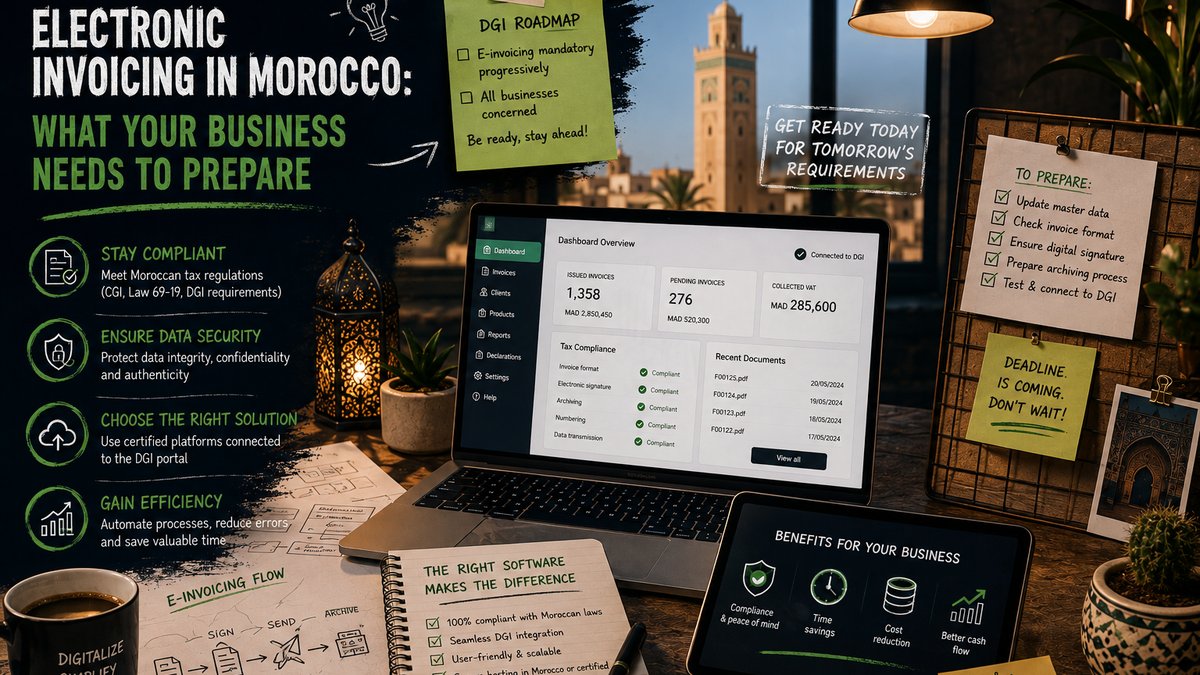
Since the reform was announced, every vendor declares itself compliant. The word costs nothing. This article sets out the verifiable criteria that separate a tool that is genuinely ready from a sales promise.
The non-negotiable criteria
Production of a structured format
Ask for a sample file in UBL 2.1 format. A vendor that is ready sends it the same day. A vendor who answers that “it is planned for the next release” is really telling you that nothing has been built.
Connection to the tax platform
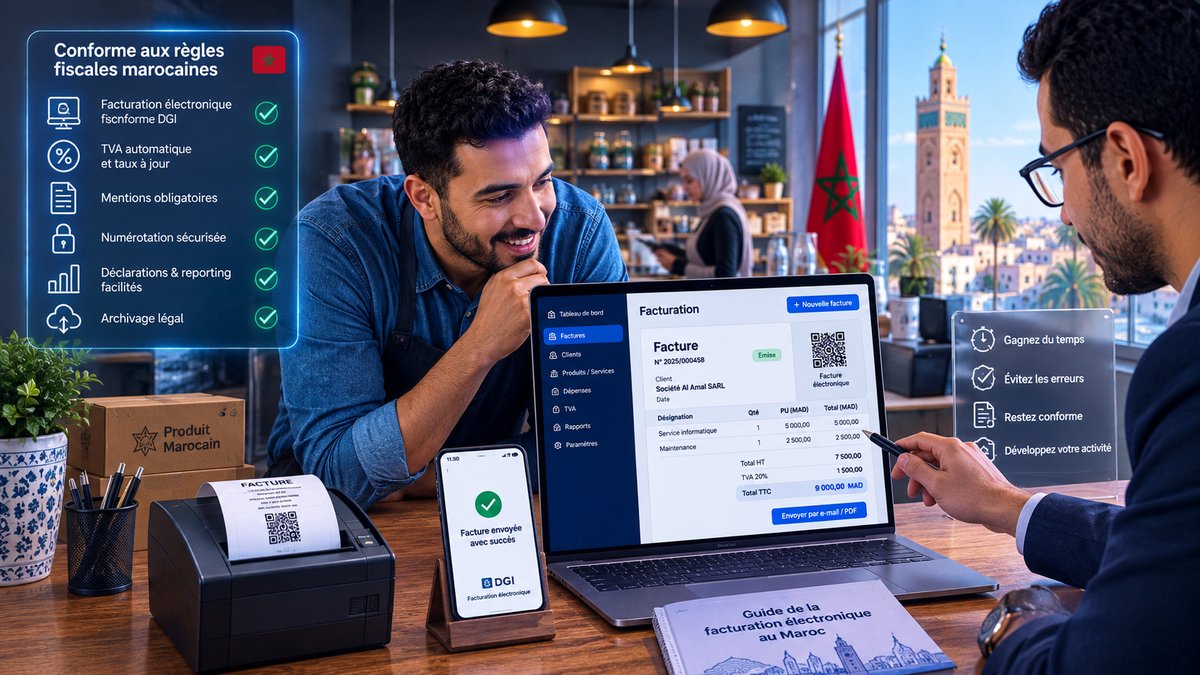
Producing the right format is not enough: you have to transmit, receive clearance and keep the proof. Ask how the solution handles a rejection and where the clearance receipt is stored.
Full handling of legal identifiers
Common company identifier, commercial register, tax ID, business tax, social security affiliation: these fields must exist natively, with format validation on entry. If they are held in a free-text “notes” field, the solution was not designed for Morocco.
Accounting compliant with the Moroccan chart of accounts
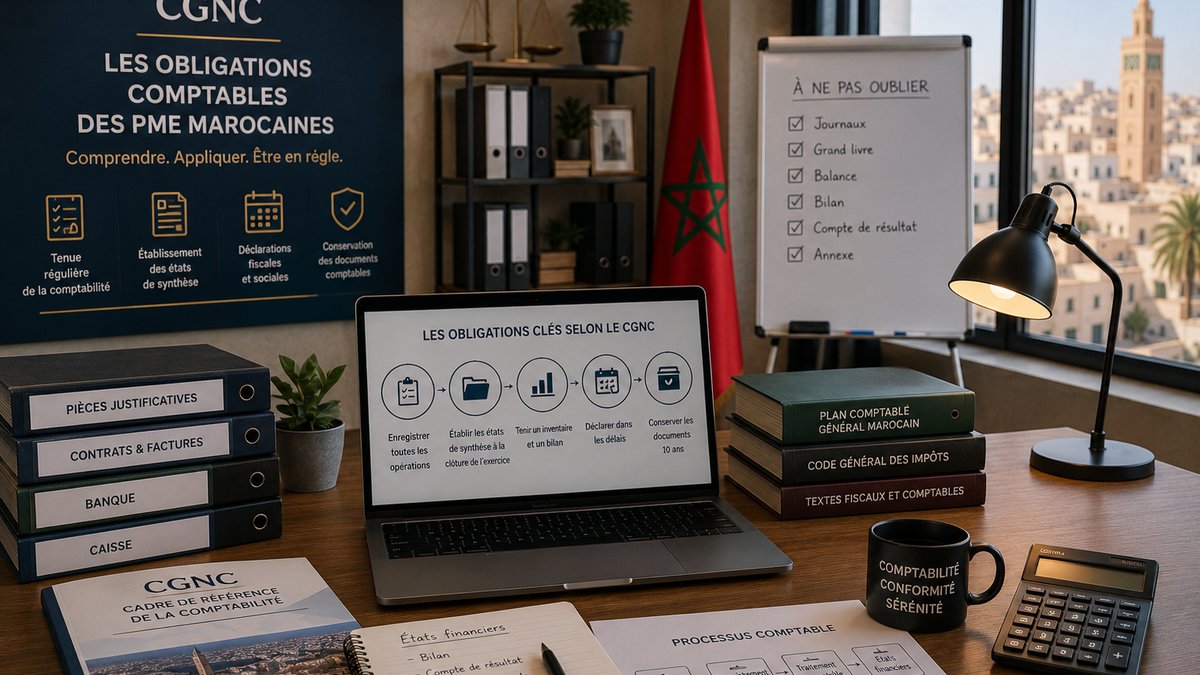
Invoicing software that ignores the national chart of accounts will force you to re-key everything at your accountant’s. See our article on the accounting obligations of Moroccan SMEs.
The criteria that make the difference in daily use
The complete document workflow
Quotation, purchase order, delivery note, invoice: the chain must be continuous, each document flowing from the previous one without re-keying. That is what saves time day to day, far more than any advanced feature.
Credit notes and corrections
With prior clearance, an issued invoice can no longer be modified. Check that the tool handles the credit note, the corrective invoice and the link between the two cleanly.
Customisable document templates
Logo, company stamp, legal mentions, payment terms: you must be able to adapt the presentation without depending on the vendor for every change.
Multi-user with permissions
The salesperson enters a quotation, the accountant validates the invoice, the manager reviews the dashboards. Three roles, three scopes. A single-user solution quickly becomes a constraint.
Questions to ask before signing
- Can I export all my data, and in what format?
- Where is the data hosted, and who has access to it?
- What happens if I stop the subscription: can I still consult the history?
- Is regulatory compliance work included or charged extra?
- What is the response time if I am blocked during a closing period?
- Is there a trial version I can run on my own data?
That last question is decisive. A demonstration on a dataset prepared by the vendor proves nothing. Test with your real customers, your real products, your real edge cases.
SaaS or installed licence
The subscription model avoids upfront investment and server maintenance. A licence installed on your own machines keeps the data with you and avoids dependence on the internet connection. Neither is superior: it depends on your infrastructure, your confidentiality constraints and your cash position.
Frequently asked questions
Can foreign software do the job?
Technically yes, provided it handles the Moroccan chart of accounts, local VAT rates and the connection to the national tax platform. In practice, few international vendors invest in those specifics.
What does a compliant solution cost?
The range is considerable depending on scope. The real cost to watch is not the licence but data migration, training and start-up support.
How long does deployment take?
For an SME with clean data, a few weeks. With a customer file that has to be rebuilt, expect several months. The quality of your existing data is the main factor in the timeline.
Our approach
SOLVIO was designed for the Moroccan context: complete document workflow, accounting under the national chart of accounts, VAT management, native legal identifiers, and deployment either by subscription or by licence. See SOLVIO in pictures or request a demonstration.