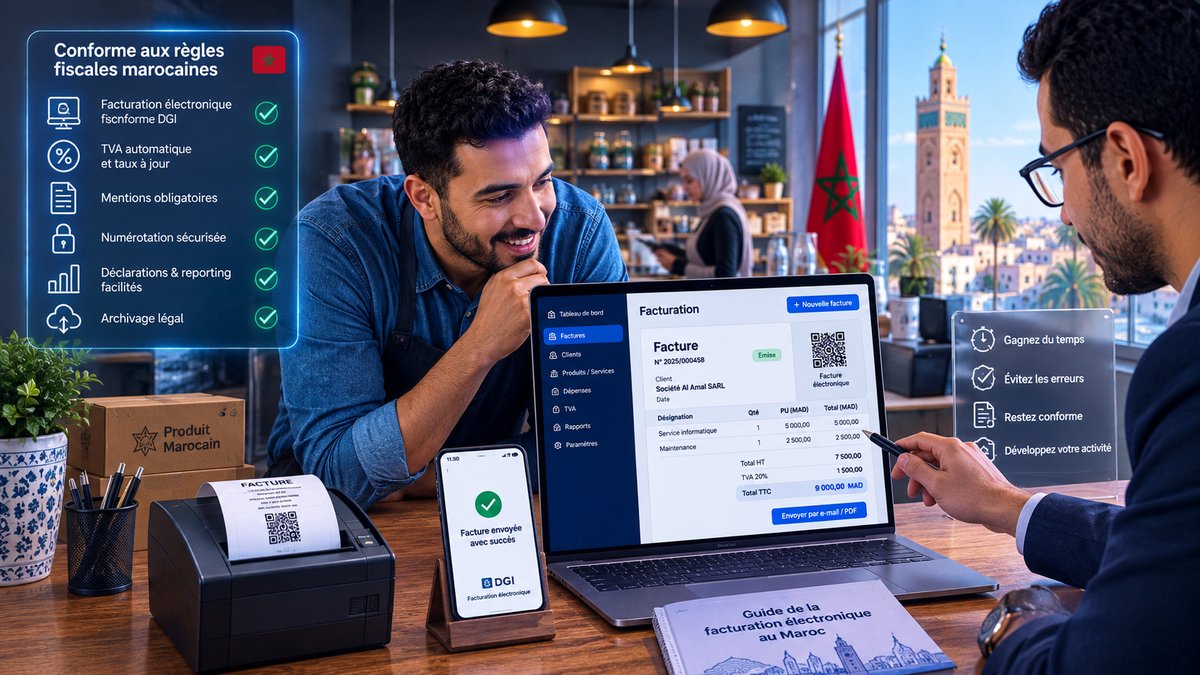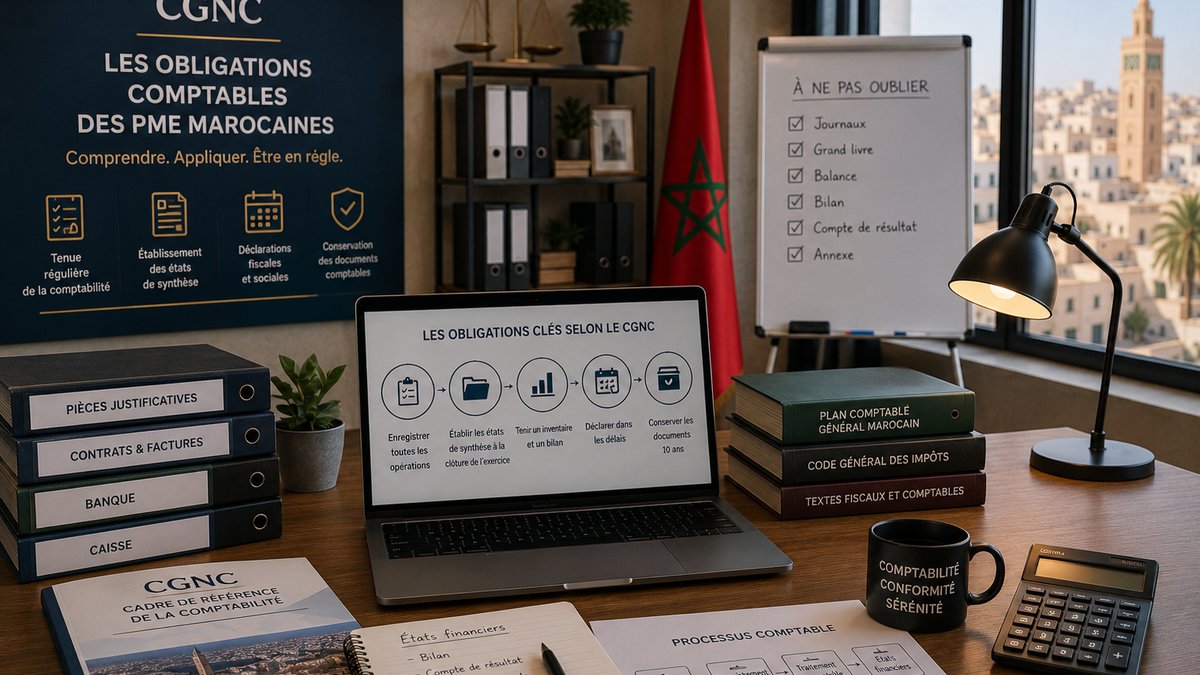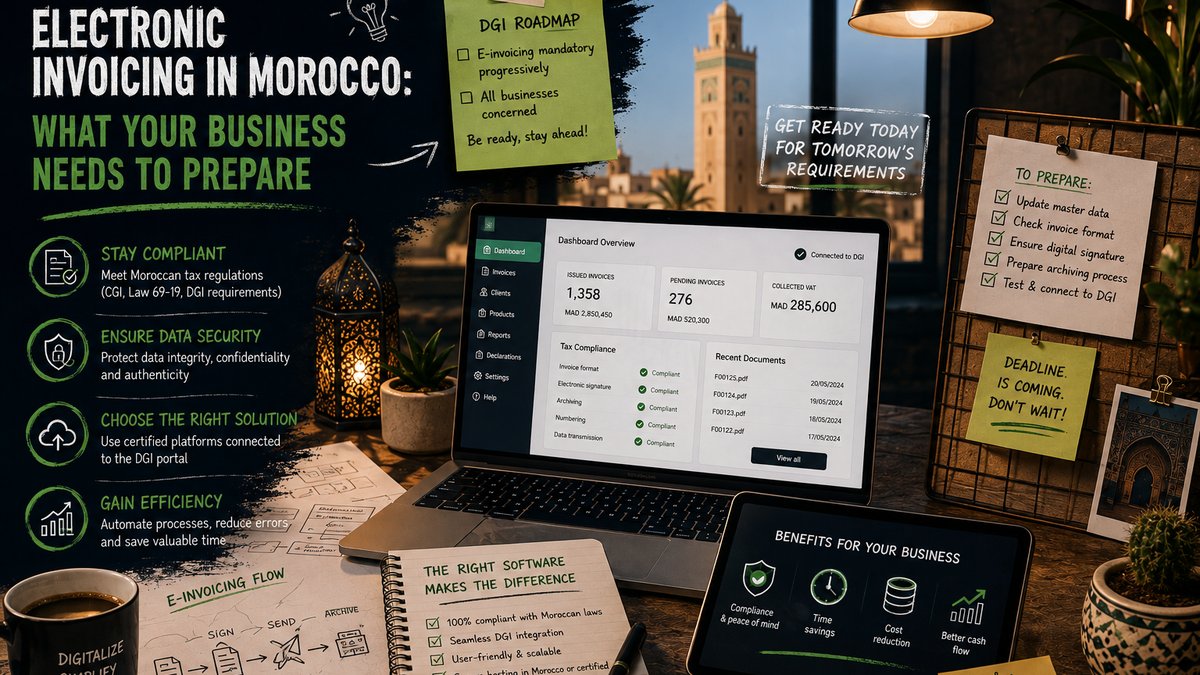
Electronic invoicing is no longer a distant project for Moroccan businesses. The Direction générale des impôts has launched a reform that will progressively make it mandatory to issue invoices in cleared electronic form. This article sets out what is established, what still needs clarifying, and above all what you can do right now.
What the reform actually changes
Today, a paper invoice or a PDF sent by email is enough to evidence a transaction. Tomorrow it will not be. Morocco has adopted the clearance model: every invoice will have to pass through the tax authority platform and be validated before it is legally valid.
This point deserves to be well understood, because it changes the very nature of the document. An invoice that has not been cleared is not a late invoice: for tax purposes it does not exist. Your customer will not be able to deduct the corresponding VAT, and your accounting entry will rest on a document with no evidential value.
This model is already in force in several countries, notably Mexico, Turkey and Saudi Arabia. Morocco is therefore following an international trend rather than running an isolated experiment.
The legal framework
The obligation rests on article 145 of the General Tax Code, supplemented by law 43-20 on trust services for electronic transactions. The implementing decree, which is to set the precise arrangements, was still at draft stage in spring 2026.
This is an important nuance: several different versions of the timetable are in circulation depending on the source. Some announce a start reserved for companies with turnover above 200 million dirhams, others mention an intermediate bracket from mid-2026, then a general rollout to smaller structures. Until the decree is published, treat any confidently stated date with caution.
What is settled, on the other hand, is the rollout logic: large companies first, then SMEs, then very small structures. And the initial scope covers business-to-business transactions.
The required formats
Only two formats will be accepted: UBL 2.1 and UN/CEFACT CII. These are not layout formats but standardised data structures, designed so that the tax platform can read and check every field automatically.
The practical consequence is direct: a PDF, however cleanly generated, will not do. Nor will an Excel file. Your invoicing tool will have to produce a structured document compliant with one of these two standards, then talk to the tax authority platform to obtain clearance.
Four projects to start now
1. Clean up your reference data
An electronic invoice is rejected if a mandatory field is missing or inconsistent. That means your customer database has to be clean: common company identifier, exact legal name, full address. It is the longest and least rewarding task, and it is the one that blocks most businesses at the moment of switching over.
2. Standardise your product catalogue
Every invoice line will have to carry a clear description, a quantity, a unit price and a consistent VAT rate. Vague labels and hand-entered rates become sources of rejection.
3. Check what your current tool can do
Put the question to your vendor: will your software produce UBL 2.1, and will it be connected to the tax platform? If the answer is slow in coming or stays vague, plan for a replacement. The issue is not the price of the upgrade, it is the lead time.
4. Anticipate exception flows
Credit notes, corrective invoices, down payments, debit notes: these are the edge cases that cause trouble once the switch is made. List them and check they are covered.
What it changes inside your organisation
Beyond the technical side, the reform changes an ingrained habit: you will no longer be able to correct an invoice after the fact by reprinting it. Once cleared, it is frozen; any correction goes through a formal credit note. Businesses that invoice approximately at the start of the month and tidy up at the end will have to review their process.
It is also an opportunity. Structured invoicing feeds accounting automatically, cuts re-keying at the accountant’s office and gives real-time visibility over turnover and output VAT.
Frequently asked questions
Is my business affected as early as 2026?
That depends on your turnover and on the final implementing decree. Large companies are targeted first, smaller structures get additional time. The principle of a phased rollout is settled; the exact thresholds remain to be confirmed.
Is a digitally signed PDF enough?
No. A PDF is not a structured format in the sense of the reform. Only UBL 2.1 and CII are accepted, with prior clearance by the tax platform.
What happens if an invoice is rejected?
It has no fiscal value until it is cleared. You correct the offending data and submit again. Hence the importance of a reliable customer and product reference base upstream.
Do I need to change invoicing software?
Not necessarily, if your vendor commits to a compliant, connected update. Otherwise, better to anticipate than to endure. See our guide on choosing compliant invoicing software.
In short
The reform is under way, its principle is clear, its precise timetable remains to be confirmed. The businesses that will come through best are not those that bought the most expensive software, but those that cleaned up their customer and product data before the deadline.
At Systomap we build SOLVIO, an ERP designed from the outset for Moroccan regulation: complete document workflow, accounting compliant with the national chart of accounts and VAT management. Let us talk about your situation.